
Wildfire Insurance in Redding, CA: What Buyers Need to Know Before Closing
You find a house in Redding, the price works, the inspection looks clean, and then the insurance quote comes back at three times what you budgeted. Or worse, no carrier will write it at all and your loan cannot fund. That sequence has become common enough in Shasta County that insurance now belongs at the front of the buying process rather than somewhere near the end of escrow.
The state has effectively said as much. The California Department of Insurance classifies Shasta as a distressed county under its catastrophe modeling regulation at 10 CCR section 2644.4.8(a)(1)(B), a designation that applies where the share of structures at high or very high wildfire risk sits at or above the 50th percentile of California counties.
Why Wildfire Insurance Drives Home Purchases in Shasta County
Insurance is a line item in most American housing markets and a gating condition in this one. Buyers moving here from the Bay Area or Sacramento are often surprised by how early the conversation has to happen, and how much the answer varies from one address to the next.
What the Distressed County Designation Means for Your Address
The Department of Insurance Availability and Affordability Report, Appendix C, records 24,645 of 71,352 Shasta County dwelling units as high or very high wildfire risk, or 34.5%, against 12.1% statewide.
Two caveats belong with that figure: the dwelling unit counts come from California Department of Finance data as of January 1, 2015, and the risk percentage is a weighted average across catastrophe modelers rather than one model's output.
Practically, the designation means carriers writing in California have commitments tied to counties like this one, and it means an underwriter looking at a Redding or Palo Cedro address starts from a different baseline than one looking at Sacramento.
How Many Local Homes Have Moved to the FAIR Plan
California FAIR Plan policies in force in Shasta County went from 1,842 on September 30, 2021 to 6,505 on September 30, 2025, with total insured value rising from roughly $1.00 billion to about $4.57 billion, according to FAIR Plan county data reported for those dates. Statewide, the plan covered more than 675,000 policyholders as of mid 2026 per California Department of Insurance and FAIR Plan reporting.
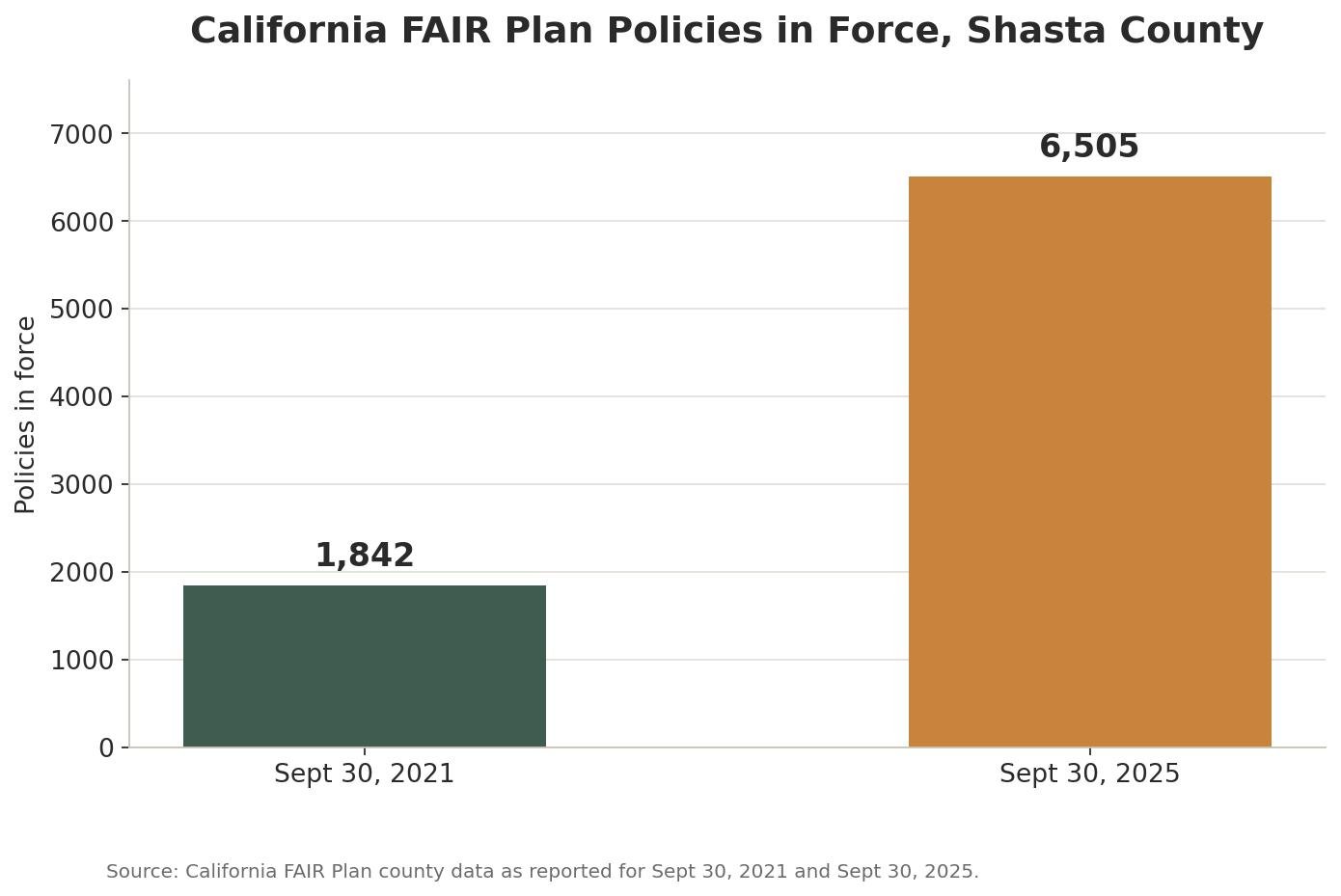
The FAIR Plan exists as the insurer of last resort. Growth on that scale locally means the standard admitted market has thinned out here, particularly on rural parcels and in foothill terrain.
Hazard Zones and Insurer Risk Scores Are Not the Same Thing
CAL FIRE fire hazard severity zones describe long-term physical hazard. Shasta County's State Responsibility Area maps took effect April 1, 2024, and updated Local Responsibility Area maps for the county were released February 10, 2025. Those maps drive building code and defensible space obligations.
Carriers use their own risk models, which factor in structure characteristics, brush and slope at the parcel, and distance to a responding station.
A home can sit in a moderate hazard zone and still price badly, or sit in a high zone and place cleanly because the roof, vents, and clearance are right. The map tells you what rules apply. Only a quote tells you what you will pay.
What the California FAIR Plan Actually Covers
Most buyers hear "FAIR Plan" and assume it is a homeowners policy with a state label on it. It is not. Understanding the difference matters before you build a monthly payment around it.
A Named Peril Policy, and What a DIC Policy Adds
The FAIR Plan dwelling policy is a named peril form. It covers fire and lightning, internal explosion, and smoke, with residential dwelling limits up to $3 million. It does not include liability, theft, water damage, or loss of use.
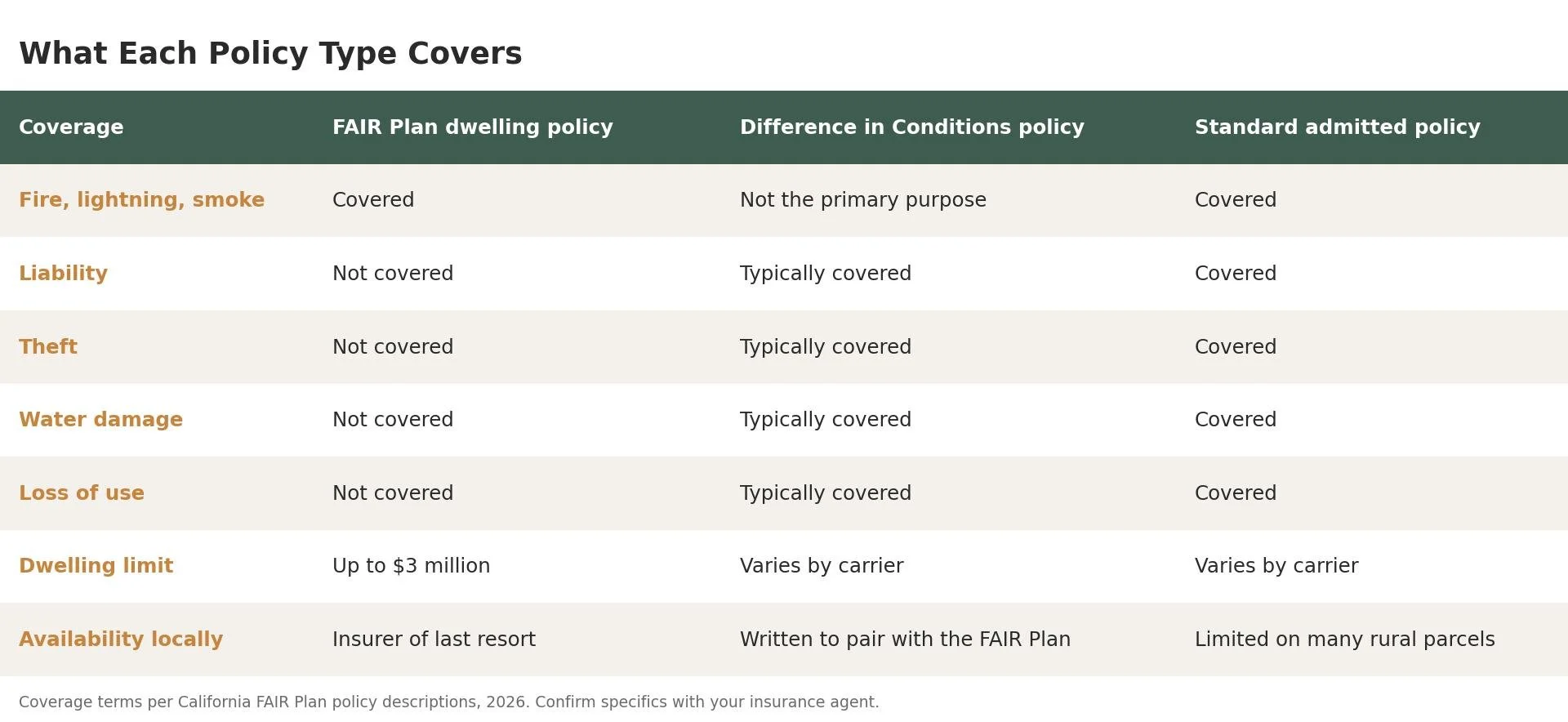
Buyers close that gap with a Difference in Conditions policy from a private carrier, written to sit alongside the FAIR Plan policy. Two policies, two premiums, two renewal dates. Your lender will have requirements about the combined coverage, and those requirements are worth confirming with the lender directly rather than assuming.
The Rate Change Taking Effect October 15, 2026
The California Department of Insurance approved an overall 29.1% average rate increase on the FAIR Plan's dwelling line, less than the 35.8% the plan had requested, effective for new and renewal business on October 15, 2026.
The increase is weighted toward the wildfire portion of the premium, so higher-risk properties absorb more of it and some lower-risk policyholders may see a decrease.
For statewide context, the average residential FAIR Plan premium was reported at roughly $3,000 to $3,200 per year on September 2025 data. Shasta County specific premium averages are not published, and applying a statewide figure to a foothill parcel outside Palo Cedro would be misleading. Get the number for the actual address.
Getting a Quote Before You Remove Contingencies in Redding
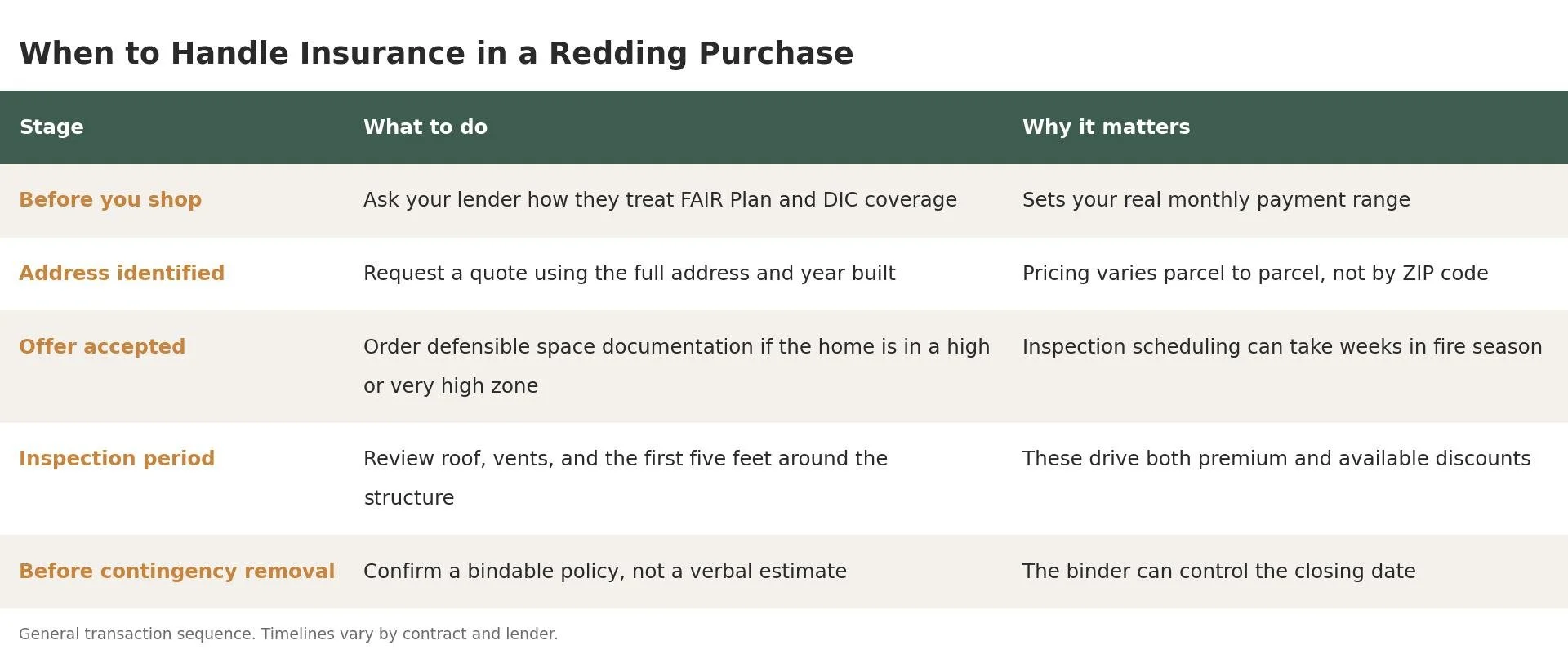
The most common question we get from out-of-area buyers is about wildfire insurance, and the most common mistake we see is waiting until after the offer is accepted to ask it. In this county, that is late.
The Address Sets the Price, Not the ZIP Code
Two homes a mile apart in west Redding can quote very differently based on slope, vegetation, road access, and roof material. The same is true moving east from Redding toward Bella Vista, or south toward Cottonwood acreage. Give an agent the full address and the year built, not the neighborhood name.
What an Underwriter Will Ask For
Expect requests for the year built, roof material and age, construction type, square footage and replacement cost, claims history, distance to a fire station and hydrant, and photographs of all sides of the structure and the surrounding clearance. On rural parcels, add water source and driveway access for apparatus.
Files with documentation attached move faster and price better than files without it. That is not negotiation, it is underwriting.
How the Premium Interacts With Your Loan
Hazard insurance sits in your escrowed payment, so a premium that comes in high changes your monthly cost and can affect qualifying. Lenders also require evidence of an acceptable bindable policy before funding, which means the binder can control the closing calendar.
At Greater Life Realty, we usually find that buyers who bring their lender and an insurance agent into the conversation at the same time run into fewer surprises in the last week of escrow. Specific qualifying and coverage-adequacy questions belong with your lender.
Wildfire Disclosures in a Shasta County Transaction
California puts specific wildfire obligations on sellers of homes in high or very high fire hazard severity zones. Buyers should know what they are entitled to receive, and sellers should know what they need to produce.
Defensible Space Documentation at Sale
Under California Civil Code section 1102.19, sellers of property in a high or very high fire hazard severity zone must provide documentation of compliance with state defensible space requirements.
If that documentation is not available before close of escrow, buyer and seller may agree in writing that the buyer will obtain it within one year of closing. Inspections take scheduling time, and fire season is the busiest window to ask for one.
The Retrofit Disclosure Added July 1, 2025
Civil Code section 1102.6f requires sellers of homes built before January 1, 2010 in those zones to disclose fire hardening features and known vulnerabilities, such as gaps in eaves, siding, or roofing where embers can enter.
On or after July 1, 2025, that notice must also include the State Fire Marshal's low-cost retrofit list and whether those retrofits were completed during the seller's ownership.
If you are on the other side of this, the selling a home process now includes assembling that paperwork earlier than most sellers expect.
Mitigation That Changes What You Pay in Shasta County

Hardening work is the one input a buyer controls. California requires carriers to recognize it, and it is applied to the wildfire portion of the premium rather than the whole policy.
What Qualifies Under Safer from Wildfires
The Safer from Wildfires framework, at 10 CCR section 2644.9, sets out the measures insurers must discount for. They include a Class A fire-rated roof, a five-foot ember-resistant zone at the structure, noncombustible material at the bottom six inches of exterior walls, ember and fire resistant vents, enclosed eaves, and cleared vegetation under decks. Community-level participation in a recognized wildfire program can also count.
Where the Zone 0 Rules Stand Right Now
The California Board of Forestry and Fire Protection approved final Zone 0 defensible space regulations on August 19, 2026, covering the first five feet around a structure in State Responsibility Areas and very high fire hazard severity zones within Local Responsibility Areas.
The package still goes to the Office of Administrative Law before it is law, and implementation is phased, with education and outreach over a multi-year period and requirements applying to new construction on adoption.
Carriers, meanwhile, are already asking about that five-foot band. Clearing it is worth doing regardless of the regulatory calendar.
Questions to Ask About a Home You Plan to Harden
Ask what the roof is and when it was installed, whether vents are ember resistant, what sits within five feet of the walls, and whether any prior defensible space inspection exists. Then ask your insurance agent what a quote looks like before the work and after it. That difference is real money, and it is knowable before you commit.
Talk to Greater Life Realty Before You Write the Offer
Insurance in this market is not a formality, and it is not a reason to walk away from Shasta County either. It is a variable you can get ahead of. If you are looking at a specific address, we can tell you what to ask about that parcel and connect you with local insurance agents who write here, well before your contingency dates start moving.
Reach out to us to talk through the property you are considering, and start with buying a home for the rest of the process. We would be glad to help guide you home to a greater life.
