
What Closing Costs Look Like When Buying a Home in Redding, CA
You have the down payment saved and the monthly payment penciled out. Then the Loan Estimate arrives with another figure near the bottom, due the same day you get the keys, that nobody mentioned when you started looking at houses.
Redfin reported a median sale price of $400,000 in Redding for the three months ending May 2026, up 4.8% from the same period a year earlier, and Freddie Mac's weekly survey put the 30-year fixed rate at 6.76% on September 10, 2026.
Neither of those numbers tells you what you hand over at the closing table. The line items below do, and a few of them work differently here than they do in the part of California most of our out-of-area buyers are moving from.
What Closing Costs Actually Cover on a Redding Home Purchase
Closing costs are not a single fee. They break into three groups, and only one of them is money that disappears. The first is what the lender charges to make the loan. The second is what third parties charge to examine, insure, and transfer the property.
The third is prepayment of taxes and insurance you would owe as a homeowner regardless, collected earlier than most buyers expect. Separating the three makes the total much less alarming.
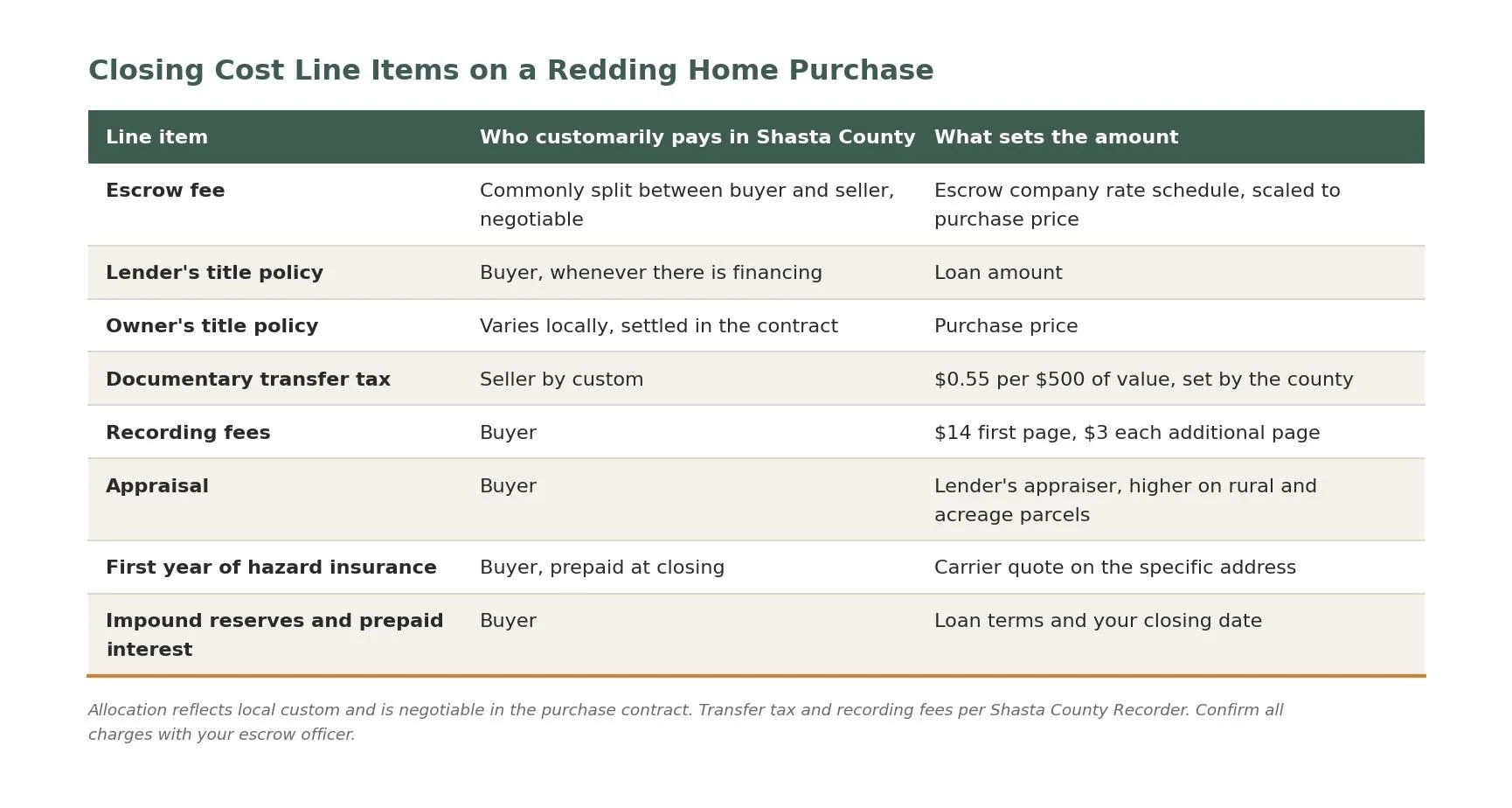
Lender Charges Versus Third-Party Charges
Lender charges include origination or underwriting fees, any discount points you buy, and the credit report pull. Third-party charges include the appraisal, escrow fees, title insurance, county recording, and a natural hazard disclosure report.
Your lender picks some of those providers and you may shop for others, a distinction that shows up directly on your Loan Estimate.
The appraisal is worth singling out. On rural parcels east toward Bella Vista or south toward Cottonwood, appraisers work with limited comparable sales and outbuildings that need valuing, and those assignments cost more and take longer than a tract home inside the city.
Loan Estimate, Closing Disclosure, and When the Number Stops Moving
Federal rules require the lender to deliver a Loan Estimate within three business days of your application and a Closing Disclosure at least three business days before closing. Compare the two side by side.
Certain lender fees cannot increase between the two documents, and certain third-party costs can only move within a limited tolerance, so an unexplained jump is a question to raise rather than absorb. Our buying a home page and the accompanying buyer resources cover where these documents fall in the sequence.
Title, Escrow, and Transfer Tax Customs in Shasta County

California closings run through escrow companies rather than closing attorneys, and who pays which escrow and title charge is a matter of local custom rather than state law. The custom is not uniform across California.
Buyers arriving from Los Angeles or San Diego often assume the arrangement they knew there applies here, and it does not always.
How Escrow Fees Get Split Here
Escrow fees in most California counties are split evenly between buyer and seller, and Shasta County follows that pattern in the county-by-county guides published by title underwriters. It stays negotiable, and the purchase contract controls.
Once you have an accepted offer, ask your escrow officer for a written estimate of charges rather than working from a rule of thumb.
Owner's Policy and Lender's Policy
Two separate policies exist. The lender's policy protects the lender for the loan amount, and the buyer pays it whenever financing is involved. The owner's policy protects you for the purchase price, for as long as you own the home, and is paid once.
Allocation of the owner's policy is where the published county guides disagree for Shasta County. Some show the seller customarily paying it, others show it split. Treat it as a negotiated term rather than a settled habit and get the answer from your escrow officer in writing.
Skipping the owner's policy to save money is a poor trade, because the lender's policy protects the lender and nobody else.
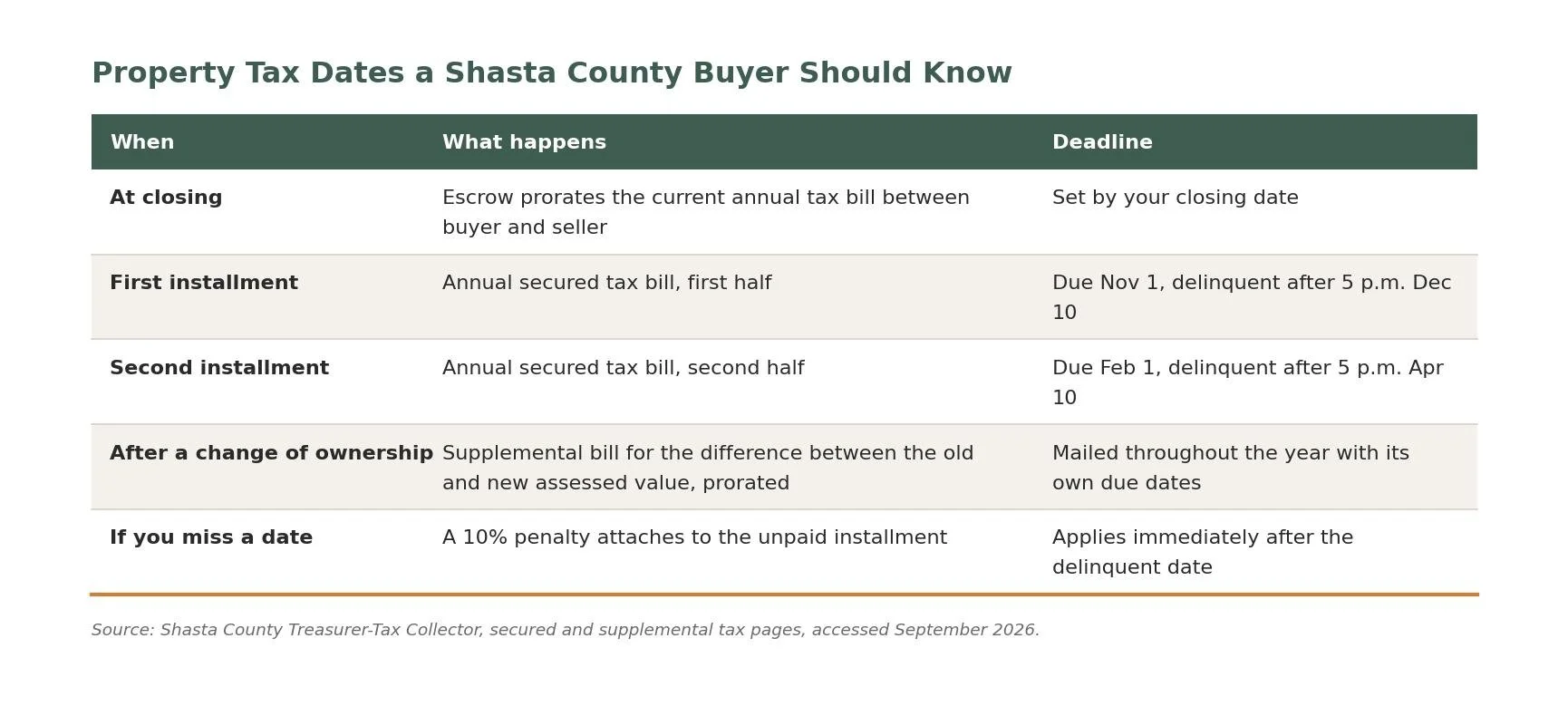
Transfer Tax and Recording Fees
The Shasta County Recorder collects documentary transfer tax at $0.55 per $500 of value, or $1.10 per $1,000, on conveyances above $100. On a $400,000 sale that comes to $440, and the seller customarily pays it.
Recording fees are small by comparison, at $14 for the first page of a document and $3 for each additional page, with a $20 charge if the Preliminary Change of Ownership Report is not submitted at recording.
These are the only figures on the statement nobody can negotiate, because the county sets them. Everything else is a price someone charges.
Property Taxes and the Supplemental Bill That Follows a Shasta County Closing
California property tax starts at the 1% base rate established by Proposition 13, with voter-approved bonds and district assessments added on top depending on your tax rate area. Buying the home triggers a reassessment at your purchase price, which is the part that catches people. The tax the seller has been paying is not the tax you will pay.
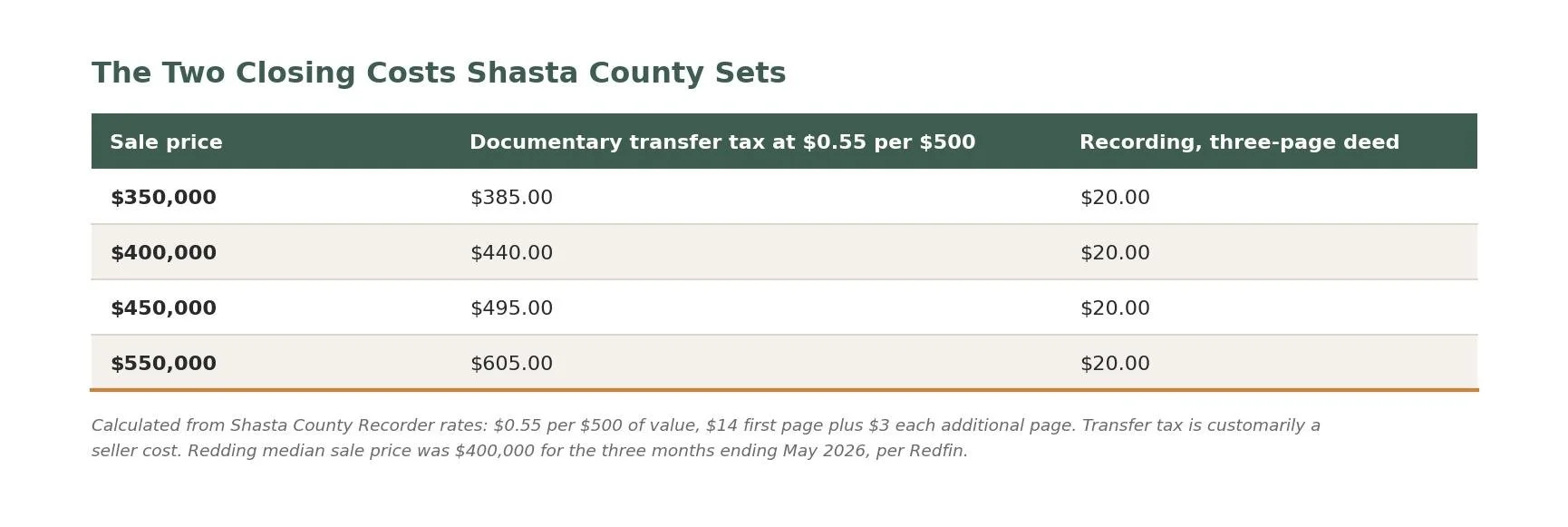
Prorations on the Settlement Statement
Shasta County bills annual secured taxes in two installments, due November 1 and February 1, delinquent after 5 p.m. on December 10 and April 10 with a 10% penalty attached.
Escrow prorates the current bill between you and the seller based on your closing date, so a closing in October looks very different on the settlement statement than one in March.
The Supplemental Bill That Arrives After You Move In
The most common cost surprise we hear about from Shasta County buyers is not anything on the Closing Disclosure. It is the supplemental tax bill that shows up months later.
When the Assessor reassesses at your purchase price, the county issues a supplemental bill covering the difference between the old assessed value and the new one, prorated for the remainder of the fiscal year.
Shasta County mails these throughout the year, separate from the annual bill, with their own due and delinquent dates. Buy a home that was assessed well below what you paid, which is common when the seller owned it for a long time, and the supplemental bill can be substantial.
It is also generally not covered by your impound account, since the lender set that up based on the prior assessment. Ask your escrow officer and your lender about it before closing, and take any questions about the calculation to the county Assessor or your CPA.
Insurance and Inspection Costs That Run Higher in Redding
Insurance enters this conversation earlier here than almost anywhere else in California. Shasta County sits in a thinner homeowners market than the state as a whole, and the first full year of coverage is paid at closing rather than billed monthly.
A premium that comes in high does not just change your monthly payment. It changes what you need at the table.
The First Year of Coverage, Paid Before You Close
Lenders require evidence of a bindable policy and collect the first year's premium through escrow. If the property ends up on the California FAIR Plan with a separate Difference in Conditions policy alongside it, that is two premiums and two sets of paperwork, both of which have to be in place before funding.
The most common question we get from out-of-area buyers is about wildfire insurance, and the buyers who ask it early are the ones whose closings stay on schedule. Get a quote on the specific address during your inspection period, not after.
Impound Reserves and What the Lender Collects
Beyond the first year's premium, the lender typically collects a cushion of insurance and several months of taxes into the impound account, plus prepaid interest for the days between closing and your first payment.
Close on the 3rd and you prepay a lot of interest days. Close on the 28th and you prepay very few. That timing choice is yours, and it is worth asking your loan officer to price both.
Well, Septic, and Pest Inspections Outside City Limits
Buyers looking at acreage in Palo Cedro, Cottonwood, or Bella Vista usually need more than a general home inspection. Well flow and water quality testing, septic inspection and pumping, and a pest report are each separate costs, and most are paid during escrow rather than at closing.
They come out of the same savings account either way. Our real estate advisors can tell you which of these a specific parcel is likely to need before you write the offer.
What Is Negotiable in a Redding Transaction

Some of these costs are fixed by the county, some are set by a provider's rate schedule, and some are purely a question of who agrees to pay. Knowing which category a line falls into tells you where there is room to work.
Working with a real estate agent who closes in this county regularly matters here, because the customs are local and the published guides do not always agree.
Seller Credits and How They Show Up
A seller credit toward closing costs is negotiated in the purchase contract and appears on your settlement statement, reducing the cash you bring. Lenders cap the size of that credit based on loan type and down payment.
Whether a seller entertains one depends on how long the home has been listed and how much competition it has, which is a property-by-property question rather than a market-wide one. Sellers weighing the other side of this can start with our selling a home page.
Lender Credits Versus Points
A lender credit reduces your closing costs in exchange for a higher interest rate. Discount points do the reverse, raising your cash at closing to lower the rate.
Which one makes sense depends on how long you expect to hold the loan, and that is a conversation for your loan officer with real numbers on both options in front of you rather than a rule of thumb.
Talk Through Your Numbers With Greater Life Realty
Closing costs become predictable once someone walks the line items with you against a specific property and a specific closing date. The buyers who get caught out are almost always the ones who asked in the last week of escrow instead of the first.
Reach out to us before you start writing offers and we will go through what to expect on a Redding purchase, what the seller side typically carries here, and which questions to put to your lender and escrow officer early. We would be glad to help guide you home to a greater life.
