
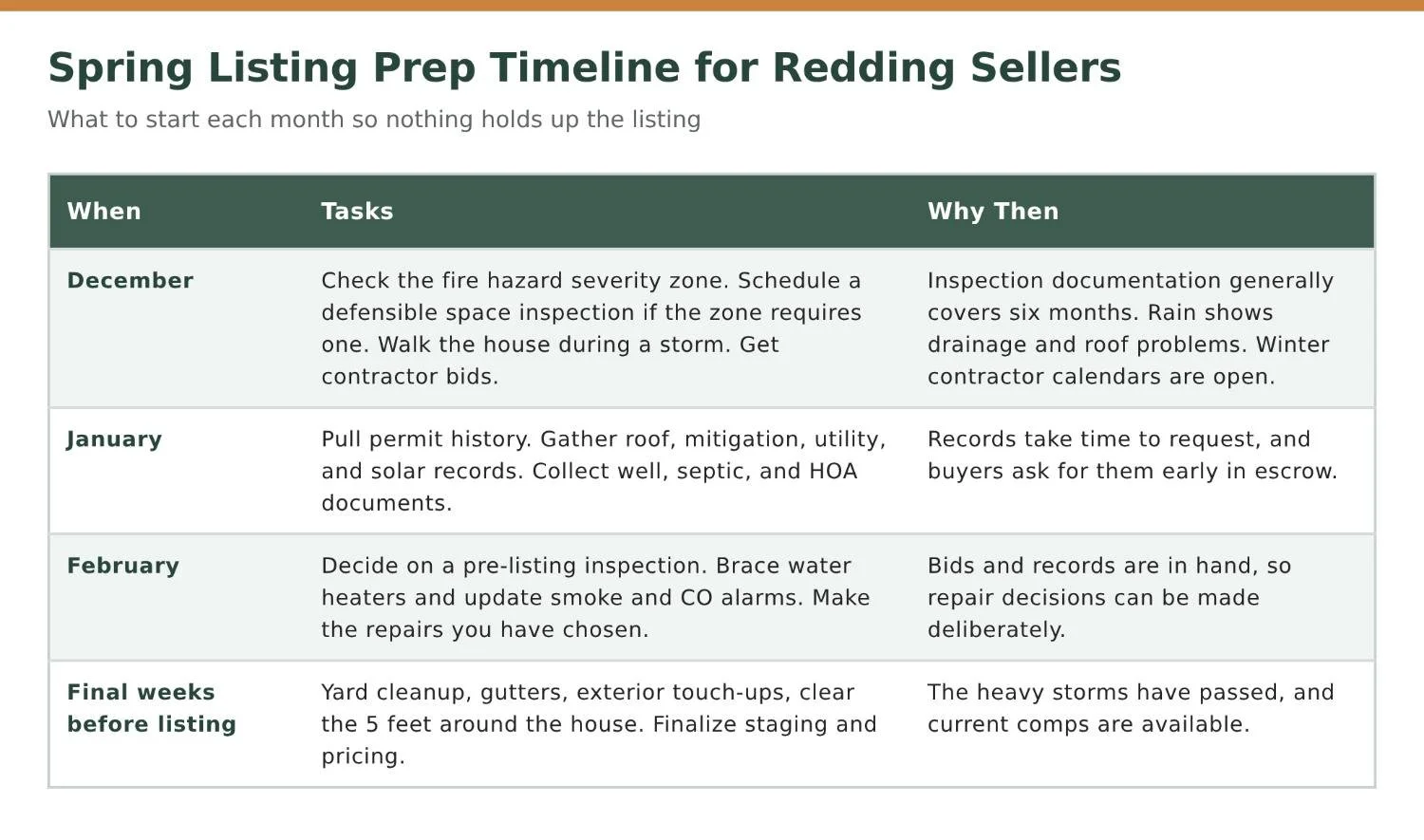
December is a hard month to think about selling a Redding home. The rain has arrived, the holidays fill the calendar, and spring feels far off. A home that lists in spring, though, competes on a faster clock.
Redding's median days on market was 56 in January 2026 and 21 in May 2026. Spring buyers decide quickly, and anything left unfinished either delays the listing or follows the home into escrow.
Most of what holds up a spring listing has nothing to do with paint or furniture. It is paperwork, inspections, and contractor schedules, and all three need a head start.
For a full picture of each stage after the sign goes up, look at how long it takes to sell a home in Redding.
Why Spring Listing Prep in Redding Starts in December
The slowest tasks depend on other people's calendars: fire agencies, building departments, roofers, electricians, and HVAC technicians.
Starting in December puts you near the front of those lines instead of behind every other seller who waited for the weather to turn. Our selling a home page lays out how we approach the listing itself.
Work That Needs Lead Time
Get bids now for anything you already know needs attention, such as a roof with visible wear, an aging HVAC system, or a deck with soft boards. Contractors who are booked solid in spring often have openings in winter.
A written bid is useful even if you decide not to do the work, because it tells you, and later a buyer, what the repair actually costs.
What Winter Rain Shows You
Redding averages about 6.3 inches of rain in December, and December through February bring roughly half of the year's total. No inspection reveals drainage problems as clearly as a storm does.
Walk the outside of the house during heavy rain. Note where gutters overflow, where water pools against the foundation, and whether downspouts carry water away from the house.
Afterward, check ceilings for new stains and look into the crawlspace for standing water. Anything you find now can be fixed before a buyer's inspector writes it up.
Fire Zone Paperwork for Redding and Shasta County Sellers
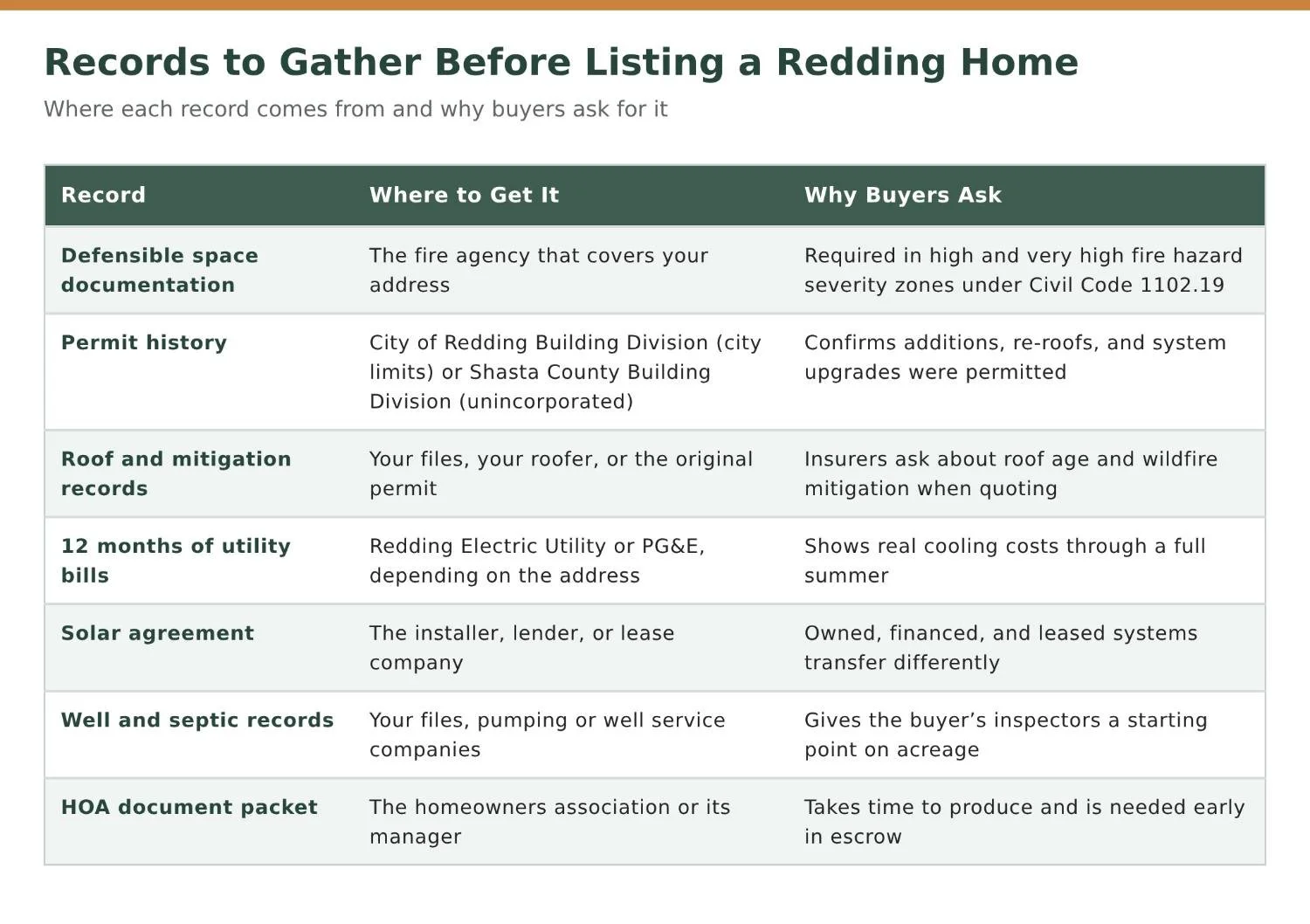
California Civil Code 1102.19, which came from AB 38, applies to sellers whose property sits in a high or very high fire hazard severity zone.
Those sellers must give the buyer documentation that the property meets state or local defensible space rules.
Whether it applies depends on the parcel, not the neighborhood, and it is the one item on this list with a legal timing window attached.
Confirming Your Fire Hazard Severity Zone
Look up the address on CAL FIRE's Fire Hazard Severity Zone viewer. CAL FIRE released updated maps for local responsibility areas in 2025 that show moderate, high, and very high zones, so a designation you remember from a few years ago may not match the current one.
The Natural Hazard Disclosure report ordered during escrow will show the zone too, but by then it is too late to plan around.
Most sellers who call us in March have not yet checked. A real estate agent in Redding, CA can pull it as part of an early listing conversation.
Timing a Defensible Space Inspection
Where the local jurisdiction has no ordinance of its own and an agency offers inspections, the documentation has to come from an inspection completed within the six months before you enter into the sale.
An inspection in mid-December covers a contract signed through about mid-June. Without documentation, the law calls for a written agreement in which the buyer takes on getting it after closing, within a deadline set by state law or local ordinance.
That is a term most sellers would rather not hand a buyer. The fire agency that covers your address can tell you whether it performs these inspections and how to schedule one.
Where Zone 0 Stands for Existing Homes
The state Board of Forestry approved its Zone 0 regulations on August 19, 2026.
They cover the first 5 feet around a structure in state responsibility areas and in very high zones within local responsibility areas, and they generally rule out wood mulch, firewood, dead leaves, and other combustible material in that band.
The rules still needed state filing before taking effect, and existing homes get a phased timeline of up to five years. You do not have to rebuild that band before a spring listing.
Clearing it is mostly cleanup, and it answers a question buyers now ask. Our post on wildfire insurance in Redding explains why buyers and their insurers care.
Records to Gather in January Before a Redding Listing
Buyers in this market are asking for documents earlier than they used to, often because an insurer or lender is asking them.
Records ready before the listing goes live keep the 17-day investigation period focused on the house rather than on missing paperwork.
Our home sellers checklist covers the general items. These are the ones specific to Redding and Shasta County.
Permit History for Past Work
Additions, garage conversions, re-roofs, electrical panel upgrades, and HVAC replacements typically require permits. Inside city limits, permit records are held by the City of Redding's Development Services Building Division.
For addresses in unincorporated Shasta County, the Shasta County Building Division holds them. Pull the history early. If something was done without a permit, January leaves time to ask the building division about options or to plan how it will be disclosed.
Roof Age and Mitigation Records
Insurance is the first hurdle for many Redding buyers, and the roof is one of the first things a carrier asks about.
Find the invoice or permit from the last roof replacement, plus records for any ember-resistant vents, gutter guards, or vegetation work. A buyer's agent who can hand those to an insurance broker on day one gets quotes back sooner.
Utility and Solar Records
Electric costs depend on who serves the address. Most homes inside Redding city limits are on Redding Electric Utility, while much of the surrounding county is served by PG&E.
Twelve months of bills show buyers what a full summer of cooling costs. If the home has solar, find the paperwork showing whether the system is owned outright, financed, or leased.
A lease or loan has to be transferred or paid off, and the company holding it works on its own timeline.
Well, Septic, and HOA Documents
On acreage, gather well logs, past water test results, and septic pumping or repair records.
Buyers will order their own inspections, as covered in our post on well and septic on Shasta County acreage, and your records give those inspectors a starting point.
If the home is in an HOA, find out now how to order the association's document packet. It takes time to produce, and the buyer will need it early in escrow.
Repairs and Inspections in February
By February the bids are in and the records are gathered, which makes it the month to decide what gets fixed. The aim is to choose deliberately rather than fix everything.
A buyer will inspect regardless, so seller repairs pay off most when they remove items that would otherwise come back as credit requests.
Deciding on a Pre-Listing Inspection
A pre-listing inspection shows you what a buyer's inspector is likely to find while you still control the timing and the contractors.
The tradeoff is that anything it turns up becomes something you know, and known material issues belong on your disclosures.
For an older home, knowing first is often worth it. Our post on home inspections in Redding covers what tends to come up by construction era. If you are unsure whether a finding has to be disclosed, ask a real estate attorney.
What to Fix and What to Disclose
Start with the items California requires at sale. Sellers certify that water heaters are braced and that smoke and carbon monoxide alarms meet state rules, and both are quick to correct.
After that, focus on anything that affects insurability or safety or could become a condition on a buyer's loan, such as active roof leaks, electrical hazards, or damaged siding.
Cosmetic items can wait. Anything you choose not to fix still goes on the disclosure forms if you know about it.
Finishing a Redding Home for Spring Photos
The last weeks before a listing are about how the home looks, and in Redding that depends on the weather breaking. Exterior photos taken under gray skies or with storm debris in the yard work against the home on every listing site.
Exterior and Yard Work After the Rain
Hold the final yard cleanup, pressure washing, and exterior touch-up paint until the heavy storms have passed.
Clear the gutters and roof valleys one more time, since winter debris shows in photos and on a roof inspection.
Keeping the 5 feet around the house free of mulch, firewood, and dead plants serves both curb appeal and the buyers asking about Zone 0.
Staging and Pricing Decisions
Staging and pricing come last because they depend on everything above: what got fixed, what will be disclosed, and what spring comps show.
Our guide on how to price your home in Redding covers the pricing side, and our home valuation tool gives you a starting number to compare against current sales.
From there, our real estate advisors can tell you how that number holds up once the first spring listings hit the market.
Plan Your Spring Listing With Greater Life Realty
Greater Life Realty helps Redding sellers handle the slowest parts of spring prep: fire zone documentation, permit history, and the records buyers' insurers ask for.
We can walk the home with you this winter and help you decide which repairs are worth making before you list.
Reach out to us and we will build a prep calendar around your home and your timeline, guiding you home to a greater life.
