
Well and Septic on Shasta County Acreage: What to Check Before You Buy
On October 16, 2026, PG&E shut off power to roughly 1,450 Shasta County customers during a Public Safety Power Shutoff.
For a home on a private well, an outage like that turns off the water too, because the pump runs on electricity.
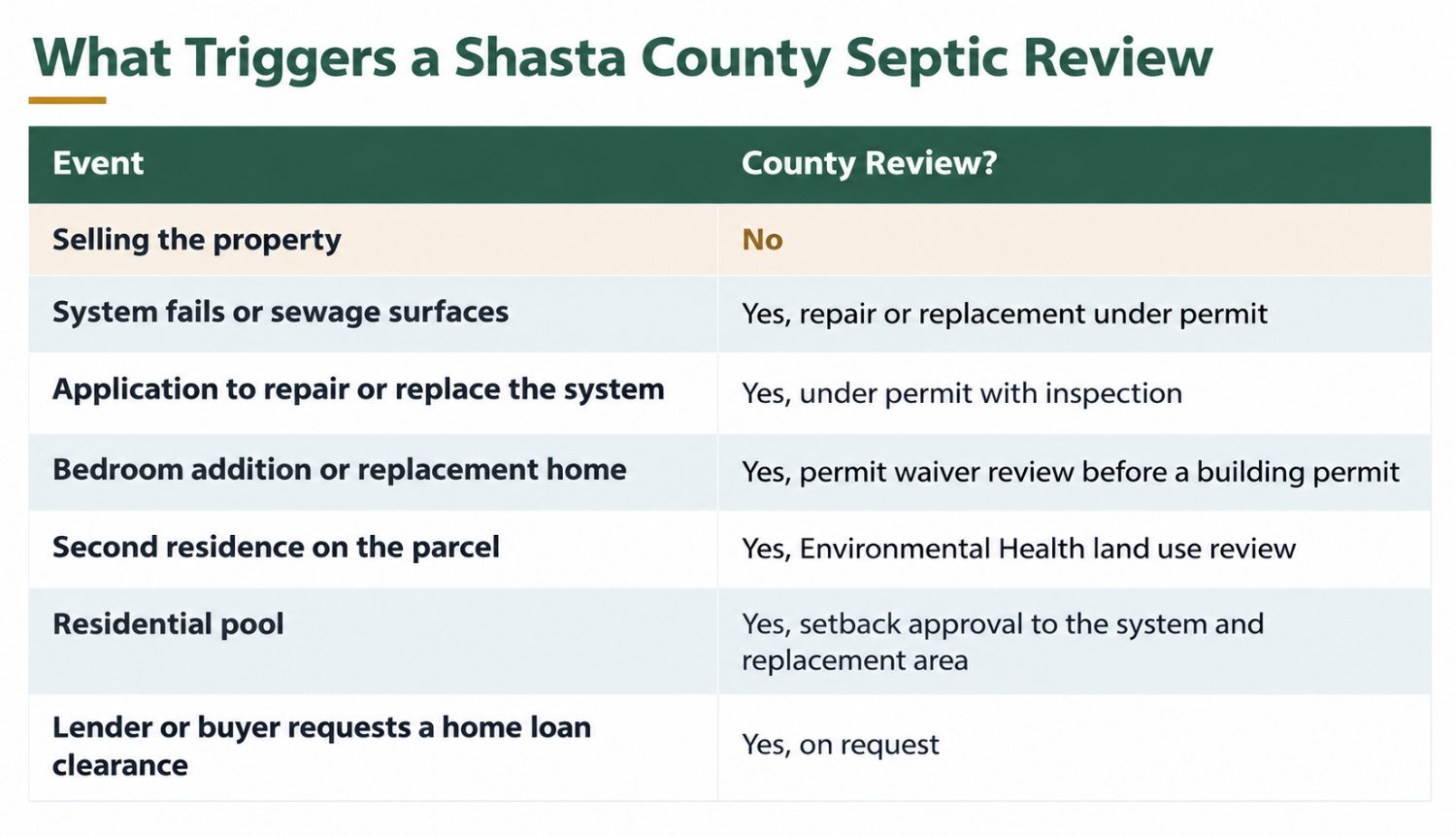
On acreage, the well and the septic system belong to you. The county permits both, but it does not inspect either one when a property changes hands.
Most buyers who ask us about acreage around Palo Cedro, Cottonwood, or Shingletown have not looked into either system yet, and the contingency period is the only window they get to find out what they are taking on.
What Shasta County Checks When Acreage Sells, and What It Leaves to You
Shasta County Environmental Health permits wells and septic systems across the unincorporated county and in Redding, Anderson, and Shasta Lake.
Under its Local Agency Management Program, revised in August 2019, an existing septic system that is not failing does not have to meet current standards.
The county reviews an existing system when it fails, when someone applies to repair or replace it, or when the owner proposes further development on the parcel. A sale is not on that list.
The Home Loan Water and Septic Waiver
The closest thing to a point-of-sale review is a clearance that some lenders or buyers request. Environmental Health checks whether the well water is potable, reviews the permit records for the well and septic system, and may inspect the site for signs of failure, damage, and adequate replacement area.
A septic waiver also requires a report from a septic pumper. Ask your lender early whether your loan calls for it.
Nobody Regulates Private Well Water
The U.S. Geological Survey states plainly that water quality in private domestic wells is not regulated in California. Testing the water before you close is the buyer's job, and keeping it safe afterward is the owner's.
Checking a Private Well in Shasta County
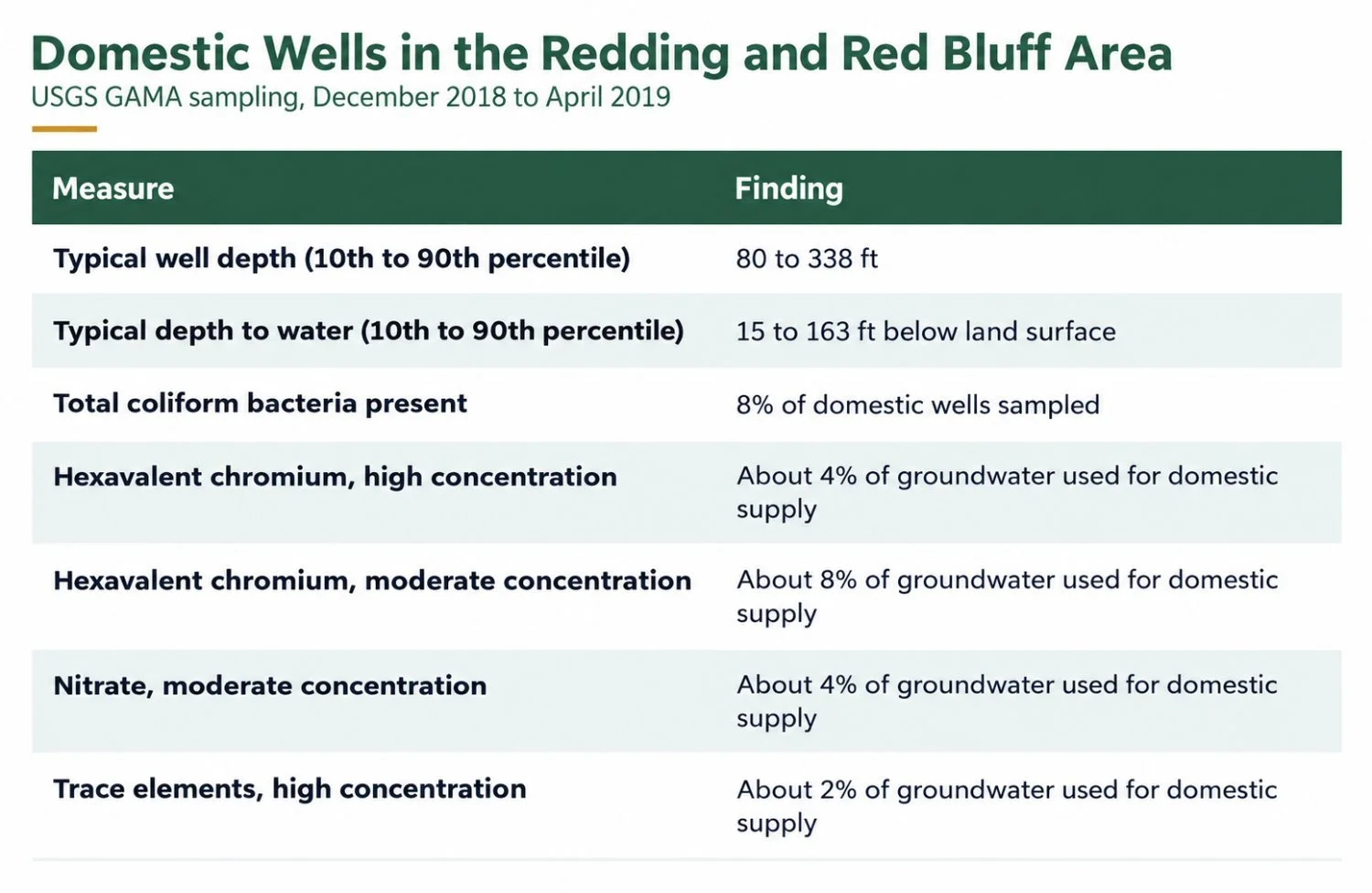
When the USGS sampled domestic wells across the Redding area and northern Sacramento Valley between December 2018 and April 2019, typical wells ran 80 to 338 feet deep, with water standing 15 to 163 feet below the surface. At that spread, a neighbor's well tells you little about yours.
Pull the Well Completion Report and Permit File
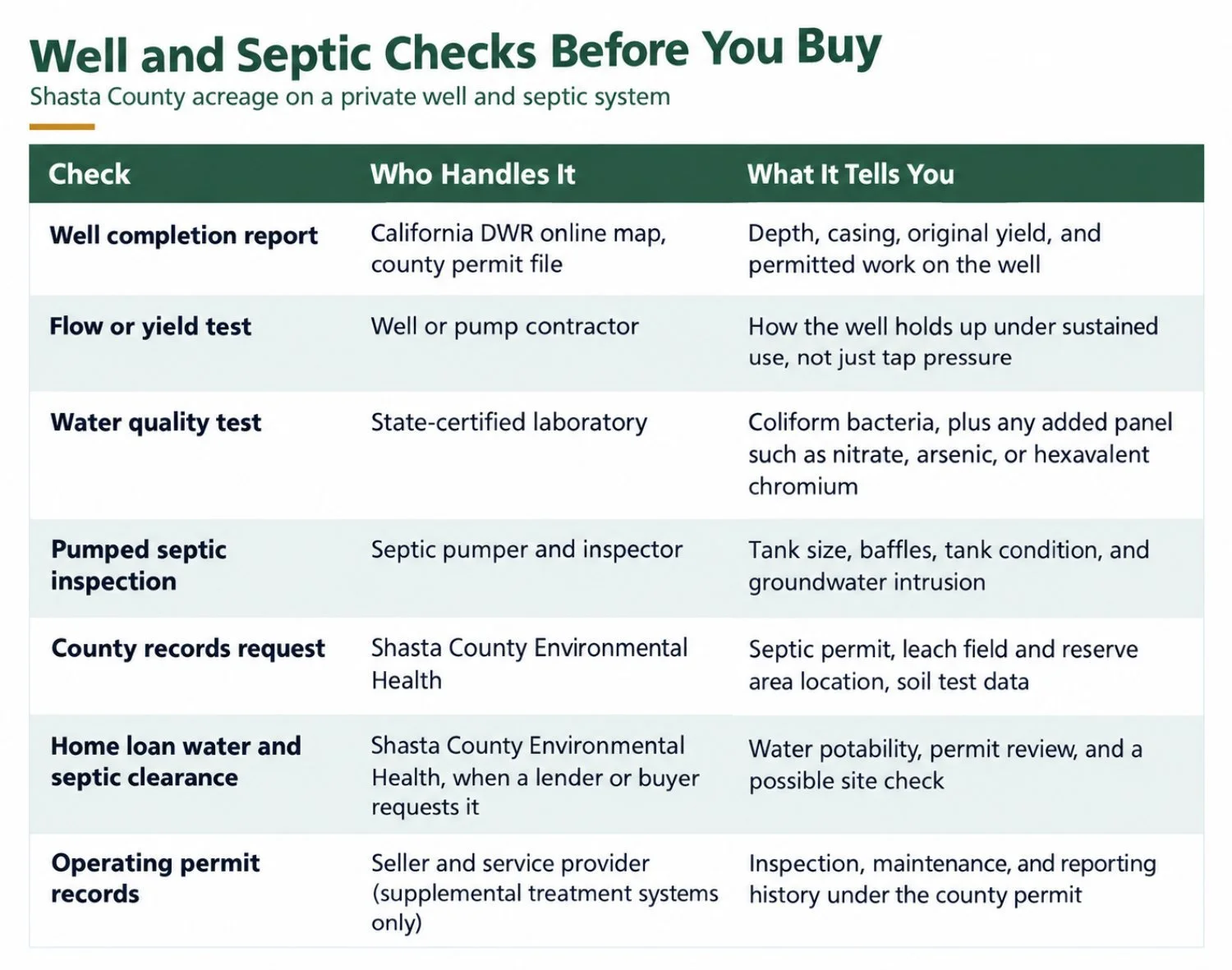
Drillers file a well completion report with the California Department of Water Resources, and DWR's online map lets you search reports by location. A report typically records depth, casing, and the yield measured when the well was drilled.
Shasta County requires a permit to drill, deepen, repair, or destroy a well, and the work must be done by a contractor holding a C-57 license, so the county file can confirm what was done and when. Older wells may have thin records or none.
Test Yield, Not Just Pressure
Strong pressure at the kitchen tap says nothing about how much water the well produces over hours of use. A flow or yield test, run by a well or pump contractor, shows how the well holds up under sustained draw.
Location matters here. Much of the valley floor around Redding and Anderson sits over the Enterprise and Anderson subbasins, which the Enterprise-Anderson Groundwater Sustainability Agency manages under state groundwater law.
Many parcels outside those mapped basins draw from fractured rock instead, and UC Cooperative Extension in Shasta County notes that less is known about those aquifers.
What to Test the Water For
A test for total coliform bacteria is the baseline, and it is what the county's home loan clearance checks. The USGS sampling found total coliforms in 8% of the domestic wells tested.
It also found hexavalent chromium at high concentrations in about 4% of the groundwater used for domestic supply and at moderate concentrations in another 8%.
California's drinking water standard for hexavalent chromium, 10 parts per billion, took effect October 1, 2024. It applies to public systems, not private wells, but it is a useful reference when results come back.
Nitrate, arsenic, and manganese are common additions to a test panel. A state-certified laboratory can recommend a panel for the location.
When the Power Goes Out, So Does the Water
PG&E serves most of Shasta County outside the Redding area. In September and October 2026 alone it issued shutoff warnings for parts of the county more than once before de-energizing customers on October 16.
A well pump stops the moment power does. Ask the seller whether the property has a generator connection or transfer switch for the pump and whether any water storage is in place. It is worth asking at the first showing, and good real estate advisors will raise it before you do.
Septic Inspections on Shasta County Property
The most common system in Shasta County is a septic tank connected to leach lines. Leach fields lose capacity gradually as a biological layer builds up in the soil, a process that can take years or decades to end in failure.
County program documents note that, short of digging into the field or reading liquid levels in inspection ports, no accepted test shows how far along a particular system is. An inspection narrows the uncertainty. It does not remove it.
Order a Pumped Inspection
Have the tank pumped as part of the inspection rather than looked at full. With the tank empty, the inspector can check the baffles, the tank's condition, and whether groundwater is seeping in, and the pumper records tank size and material on the report the county uses for its septic waiver.
The county's program says pumping frequency depends on tank size and use, with three years as a general benchmark, so ask the seller when it was last pumped and for the receipt.
Request the County's Records on the Parcel
Environmental Health treats most of its files as public records, including septic permits, installation records, site drawings, soil test data, well drilling applications, and water sample results from earlier home loan clearances.
A permit drawing shows where the leach field and the reserve area sit, which a seller often cannot point to. Parcels created before 1982 were not routinely soil tested, so an older rural lot may have little on file, and a future repair can require new testing by a qualified professional.
Supplemental Treatment Systems Carry an Operating Permit
Where shallow soil or groundwater rules out a conventional system, the county permits alternatives such as mounds, drip dispersal, and supplemental treatment units.
A system with supplemental treatment runs under a county operating permit that requires inspection, maintenance, and monitoring every 6 to 12 months, typically through a contracted service provider, with results reported to the county.
If the property has one, ask for the operation and maintenance manual, the service contract, and recent reports. Those obligations come with the home.
What a Shasta County Septic System Lets You Build
Buyers often look at acreage with a shop, pool, second unit, or extra bedroom in mind, and the septic system decides how much of that is possible.
Under county rules, the system and a replacement area sized for 100% of the design flow must fit on the parcel while meeting setbacks from dwellings, wells, pools, barns, shops, garages, driveways, and paved areas.
Bedroom Additions and Second Units
Septic systems are sized largely on bedroom count, so a building permit for a bedroom addition or replacement home on an existing system goes through an Environmental Health permit waiver review first.
The county also reviews proposals for a second residence on property served by septic. If the existing system turns out to be substantially out of compliance, the county can bar additions that would increase wastewater flow until the system is upgraded.
Confirm what the system was permitted for before paying for space you plan to finish later.
Pools, Shops, and Driveways
Before a residential pool goes in on a property served by septic, Environmental Health must approve it and check setbacks to both the existing system and the replacement area.
The county lists vehicles driving over a leach field and grading changes near it among the causes of failure, and heavy loads stored over a tank can damage it. Walk the property with the permit drawing in hand before you decide where anything new goes.
Fitting Well and Septic Checks Into a Shasta County Escrow
Contingency periods are short, and well and septic work depends on pumpers, well contractors, and labs that need days to return results.
Insurance quotes run on the same clock, which our post on wildfire insurance in Redding covers, and inspection costs belong in the budget alongside the items in our Redding closing costs breakdown.
Bare land runs on a slower timeline. A new septic system may need groundwater monitoring, which for most land is read from January through April, and the county generally accepts it only in a season with at least 80% of normal rainfall.
Book Both Inspections in the First Week
We usually see well and septic inspections booked last, after the general home inspection, even though they carry the longest lead times.
Order the pumped septic inspection, the flow test, and the water sample as soon as the offer is accepted, and add the county home loan clearance if your lender needs it.
Confirm first which water and sewer arrangement serves the parcel; Palo Cedro alone has three, as our Palo Cedro buyer's post explains.
Anyone hiring a real estate agent for a rural purchase should expect these calls to start the day the offer is accepted.
When an Inspection Finds a Problem
The county treats a cracked distribution box or a broken pipe as a minor repair, fixed under permit without bringing the whole system up to current standards.
A failing leach field or a damaged tank is a major repair. It requires a county permit, soil testing by a qualified professional, and a design that meets current rules as closely as the site allows, which can mean adding supplemental treatment.
Low well yield can mean deepening or drilling a new well, both under permit. Get a written scope from the contractor before you negotiate, then decide whether to ask for a repair, a credit, or a price change.
How those options play out depends on your purchase contract, and our buying a home page walks through how we handle that stage with clients.
Buying Acreage in Shasta County With Greater Life Realty
Rural property in Shasta County rewards buyers who ask about the well and septic before they fall for the view. We help clients pull county records, book inspections early, and read the results before contingencies run out.
If you are looking at acreage anywhere around Redding, Reach out to us. We will help you understand what sits under the ground before you commit, and guide you home to a greater life.
