
How to Price Your Home in Redding, CA (and Why Overpricing Costs You)
Every seller feels the same pull. Set the price a little high to leave room to negotiate, or just to test what the market will bear. It feels safe. In today's Redding market, it is one of the costliest moves you can make.
The asking price you choose in your first week is the single most important marketing decision in your entire sale. Get it right and the home sells quickly and close to your number.
Set it too high and the market quietly punishes you, often ending in a lower final sale price than if you had priced it correctly from the start. Here is how to price your home in Redding, and exactly what overpricing costs you.
Start With What the Redding Market Is Actually Doing
You cannot price a home in a vacuum. The right number depends on what buyers in your area are doing right now.
A Balanced Market Changes the Math
Redding has moved out of the bidding-war years into a balanced market, with roughly 2.9 to 3.6 months of inventory heading through 2026. Buyers have choices and a little negotiating room again.
The good news for sellers is that pricing accuracy is still rewarded, since well-priced homes sell in about 30 to 45 days and close near 98 percent of asking. The catch is that the old playbook is dead.
Listing 15 percent above market and waiting for a bidding war does not work anymore. When buyers can line your home up against several others in the same range, an inflated price simply sends them to the competition.
Price Is Local, Right Down to the Neighborhood
The countywide median, around $400,000, is almost useless for pricing your specific home. Redding is a patchwork of submarkets. Anderson and Shasta Lake commonly run in the $300,000 to $340,000 range, while Palo Cedro, Tierra Oaks, and much of West Redding sit north of $420,000.
A correct price reflects what homes like yours, in your neighborhood, at your size and condition, have actually been selling for. Pricing off a citywide average, or off what a neighbor got two years ago, is how good homes end up mispriced.
How to Set the Right Price
With the market context in hand, setting the number comes down to a few reliable moves.
Lean on Recent Comps and Pending Sales
The most reliable anchor is recent comparable sales. Pull homes that sold in the last 60 to 90 days, within about a half mile, matched as closely as possible on square footage, bedroom count, age, and condition.
Closed sales tell you what buyers have paid, while pending sales tell you what they are paying right now, which makes them the closest thing to next month's data.
If comparable homes are closing at a lower price per square foot than your target, that gap is your warning before you ever go live.
Price to the Search Brackets Buyers Use

Buyers do not browse in fine increments. They search in round brackets: up to $400,000, up to $450,000, and so on. Price your home at $410,000 and you disappear from every buyer who capped their search at $400,000, even though many could afford and would happily tour your home.
Pricing right at a bracket edge, say $399,000 instead of $410,000, exposes your listing to a far larger pool of buyers. It is one of the simplest and most overlooked levers in pricing.
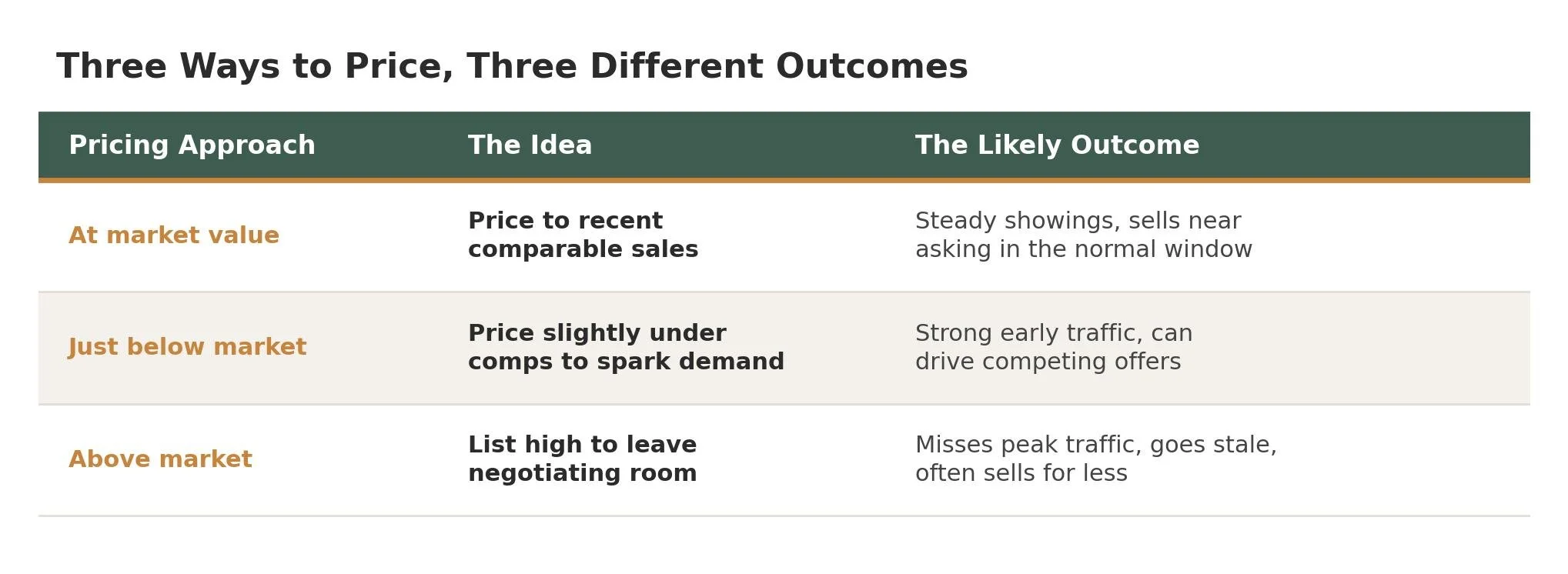
Price At or Just Below Market to Build Momentum
Counterintuitive as it sounds, pricing right at or even slightly below market value is often the strongest play. A sharply priced home draws more showings in its first days, and heavy early interest is exactly what produces competing offers that can push the final number up to or past your asking price.
You are not leaving money behind, you are using the market's own momentum to find your home's true ceiling.
[sdsdsds]
Why Overpricing Costs You
Overpricing is not a harmless experiment you can simply undo with a later price cut. It sets off a chain of events that works against you from day one.
You Miss the First Two Weeks, When It Matters Most
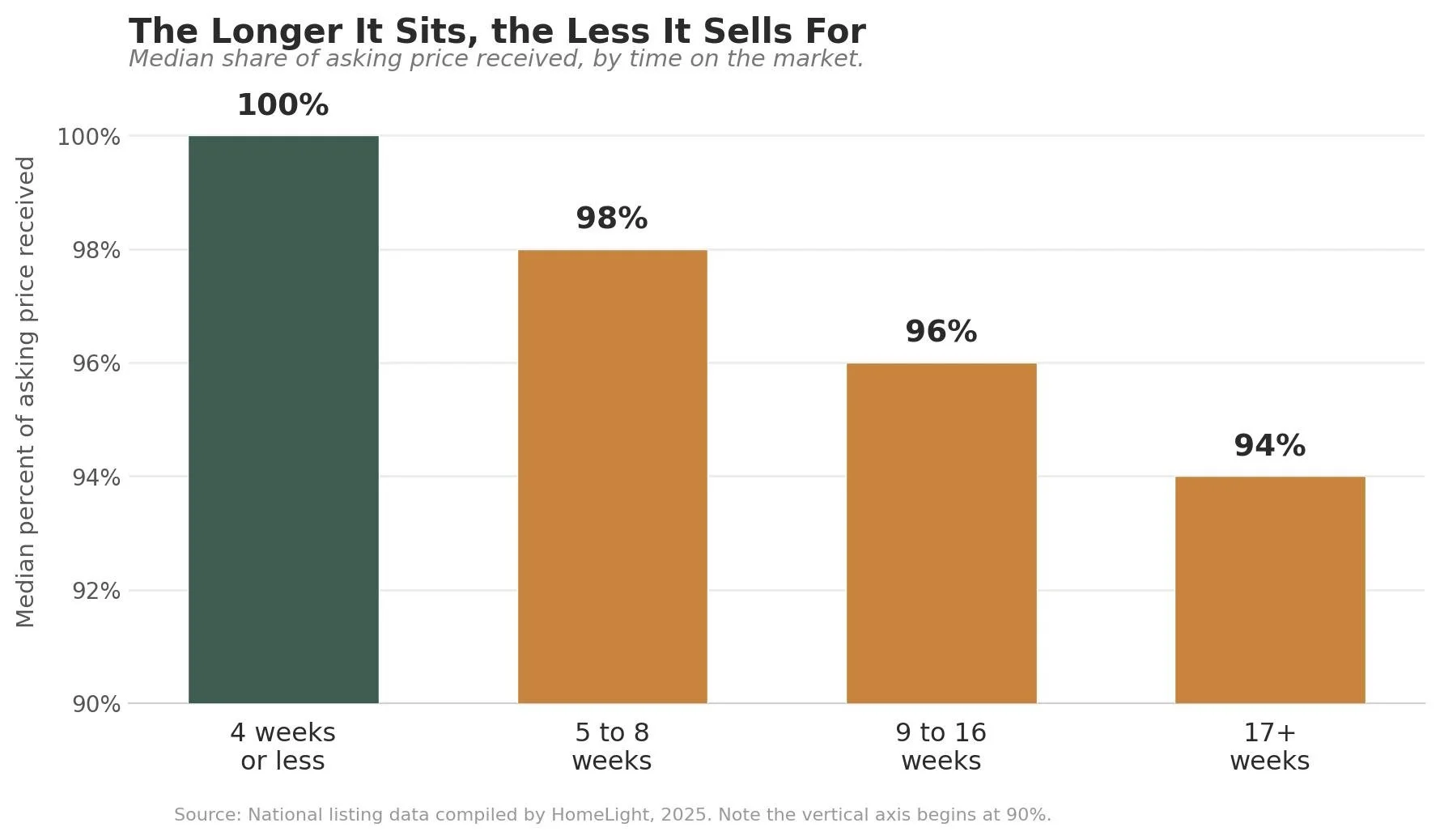
The first two weeks on the market are your golden window. That is when your listing is freshest, agent alerts are firing, and the most motivated, ready-to-act buyers see it. The numbers are stark.
Homes that sell within about four weeks tend to fetch close to 100 %of asking, while those still sitting after 17 weeks typically net around 94%. An overpriced home wastes its best, highest-traffic moment talking to buyers who scroll right past it.
Your Listing Goes Stale
Once a listing passes about 30 days without an offer, buyer psychology flips. Shoppers start asking what is wrong with it, even when the only problem is the price. The listing develops a stale reputation, and stale listings attract bargain hunters rather than serious market-rate buyers.
Locally, this is exactly the pattern agents see, with overpriced Redding homes commonly sitting 90 days or more, then taking one or two reductions before they finally sell.
You End Up Chasing the Market Down
Here is the cruel irony. Sellers who price high to get more often get less. Every visible price cut signals weakness, and a string of small trims spread over months reads as desperation, which invites lowball offers.
Worse, in a softening segment you can end up chasing the market downward, always a step behind where you should have priced in the first place. Homes that linger routinely sell for several percent below where a correct initial price would have landed them.
The Appraisal Can Still Sink the Deal
Suppose you do find a buyer willing to meet your inflated price. The deal is still not safe. Most buyers finance their purchase, and their lender orders an independent appraisal to confirm the home is worth the loan.
If the appraisal comes in below your price, the buyer has to cover the difference in cash or the financing falls apart and the sale collapses, sending you back to square one with even more days on market behind you.
How to Tell If Your Home Is Overpriced
The market will tell you quickly if your number is off. You just have to read the signals honestly.
Read the Showing and Traffic Signals
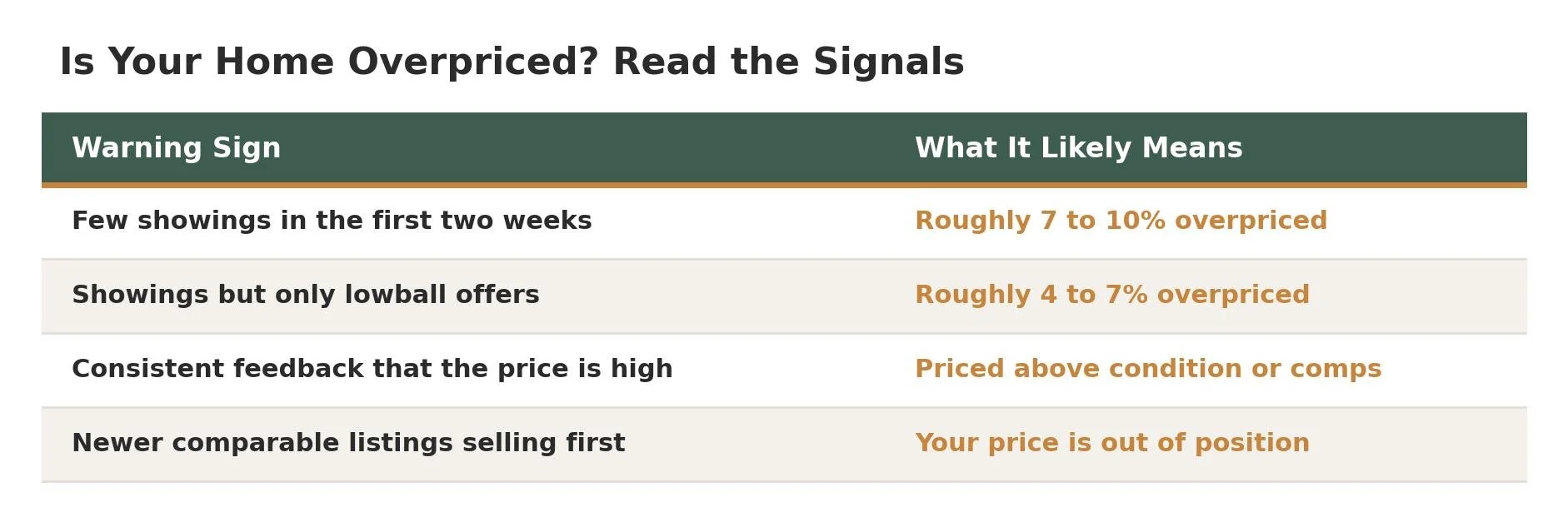
Your showing activity is honest feedback. If your home draws few showings in its first two weeks, the price is likely 7-10% too high, since buyers are filtering it out before they ever walk in.
If you are getting showings but only lowball offers, you are usually closer, roughly 4-7% over, because buyers see the home but not the value at that number. And when several buyers or their agents independently call the price high, that consensus is the market speaking plainly.
Make One Decisive Cut, Not a Trickle
If the signals are clear, act decisively. A meaningful reduction of 3-5% does two things at once. It signals that you are serious, and it moves your home into the next search bracket where a fresh pool of buyers will finally see it.
Tiny cuts under 2% are nearly invisible, since the listing stays in the same bracket on the major sites and reaches no new buyers. One confident, well-sized correction almost always beats a slow drip of small trims that only prolongs the slide.
Price It Right From Day One
The thread running through all of this is simple. The right price from day one is the most powerful tool you have as a seller.
It is what gets your home seen, toured, and sold quickly and for the best price the market will support. Overpricing does the opposite, quietly and expensively, and a later price cut rarely undoes the damage.
That is the part we take seriously at Greater Life Realty. We price every listing on current, neighborhood-level comps and pending sales across Redding, Anderson, Palo Cedro, Cottonwood, and Shasta Lake, not guesswork or wishful thinking, so your home launches strong and avoids the stale-listing spiral altogether.
If you are thinking about selling a home in Redding, CA, start with a clear, honest valuation built on what your specific market is doing right now. Contact us today and let us guide you home to a greater life.
