
What's My Redding Home Worth? How Home Values Are Determined in Shasta County
It is the first question almost every homeowner asks before they sell, refinance, or simply get curious about their equity: what's my Redding home worth? It feels like it should have a single, clean answer. Type your address into a website and a number appears, so that must be it, right?
Not quite. The number that actually matters is what a real, qualified buyer will pay for your specific home, in your specific neighborhood, in today's market. That figure is shaped by local sales, the condition of your property, and a few Shasta County realities that national estimate tools never see.
Here is how home values are determined in Shasta County, and why the answer is more specific than any median number suggests.
What Your Home's Value Actually Means in 2026
Before you can price a home, it helps to separate the idea of "value" from the numbers floating around online.
Market Value Versus the Number in Your Head
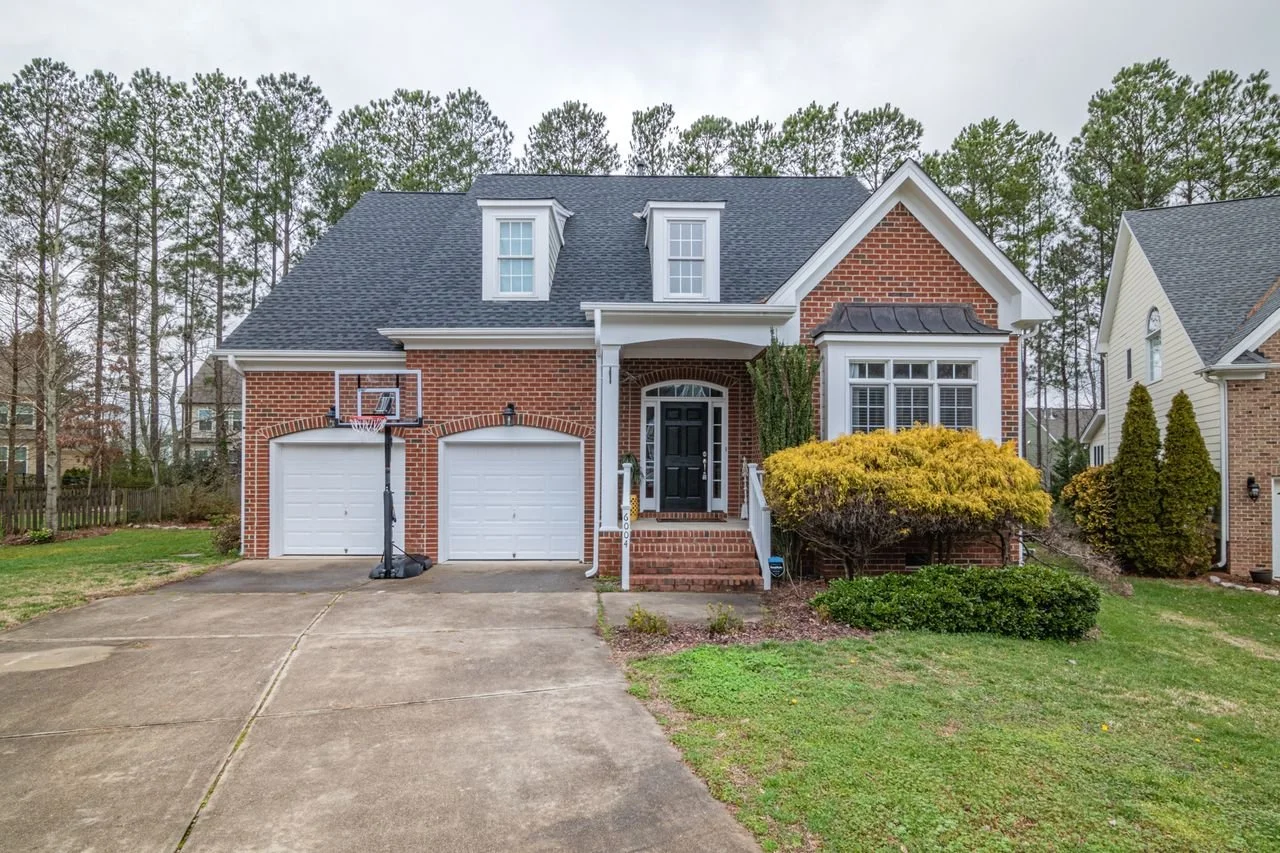
Market value is the price a willing buyer and a willing seller agree on, with neither under pressure to act. It is not what you paid, not what you owe, and not what you feel the home is worth after years of memories and improvements.
Buyers do not price in your emotional attachment. They price in what comparable homes have recently sold for and what they can reasonably afford.
Everything else in this guide is really about closing the gap between the number in your head and the number the market will support.
Where the Shasta County Market Sits Right Now
Context matters, because the same home is worth more in a hot market than a slow one. Heading into 2026, Shasta County is a balanced seller's market. Inventory is healthier than the frenzy of 2021 and 2022, but well-priced homes still move. Here is the snapshot:
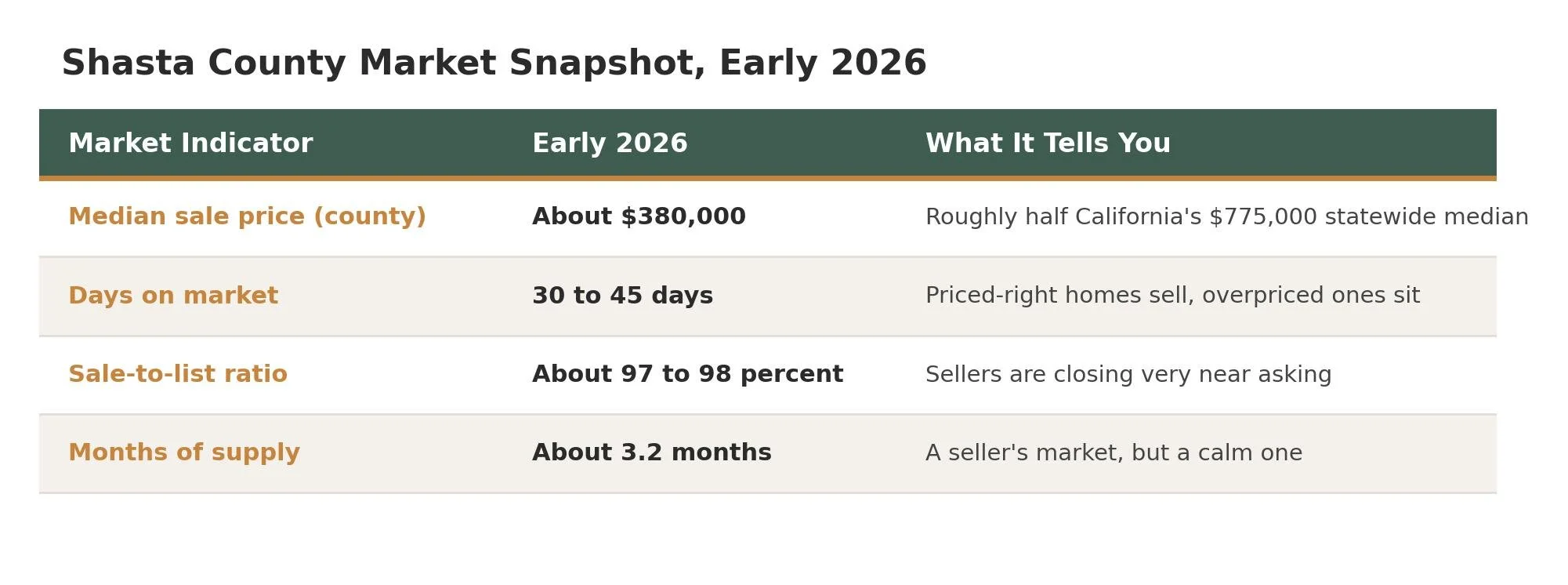
The takeaway is that pricing accuracy is rewarded. Homes priced to the market sell close to ask in about a month. Homes priced on hope tend to sit, then sell for less after a price cut.
The Three Ways a Home's Value Gets Measured
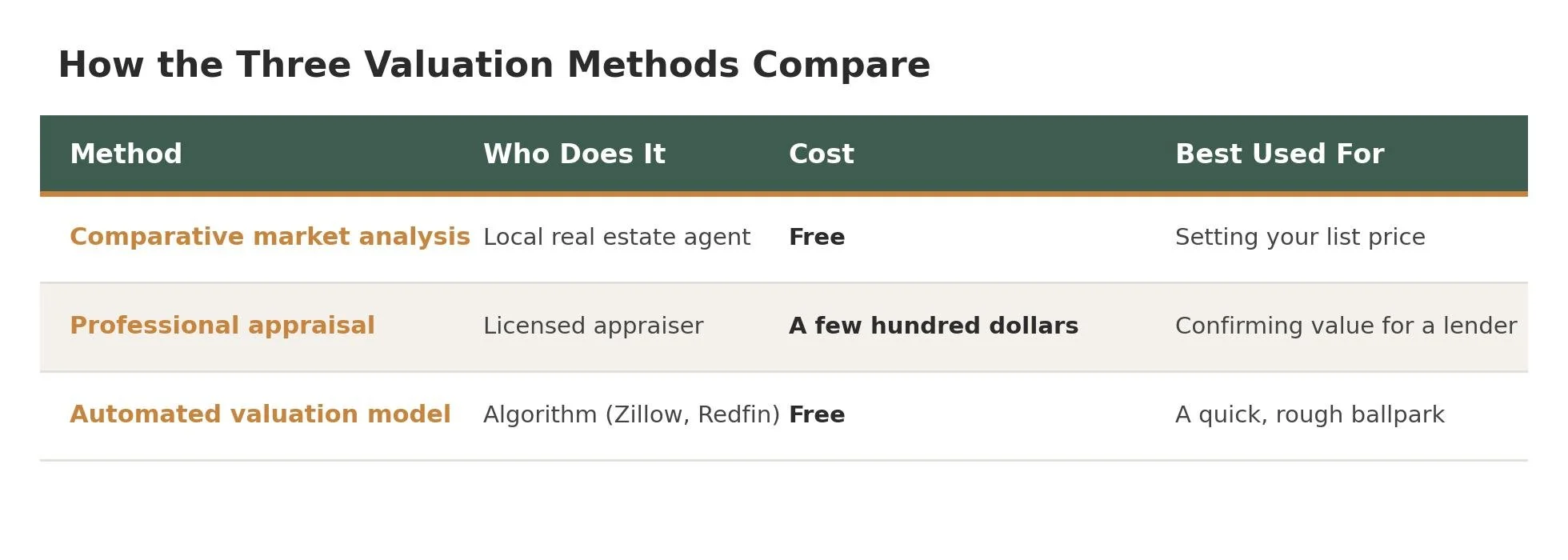
When people try to answer "what's my home worth," they are usually looking at one of three tools. Each has a place, and each has limits.
The Comparative Market Analysis
A comparative market analysis, or CMA, is the report a local agent prepares to estimate your home's market value. It works on the principle of substitution: a buyer will not pay more for your home when a similar one is available for less.
The agent pulls recent sales of homes like yours, same area, similar size, age, beds, baths, and condition, then adjusts up or down for the differences.
Because it blends real local sales with human judgment about your specific property, the CMA is the most reliable starting point for setting a list price.
The same analysis works in reverse for anyone buying a home in Redding, CA, since it points a buyer toward a fair offer the same way it points a seller toward a fair asking price.
The Professional Appraisal
An appraisal is a formal opinion of value from a licensed, independent appraiser who physically inspects the home. Lenders require one during escrow to confirm the loan amount matches the property's worth, so the appraisal often becomes the moment of truth in a sale.
It carries more authority than a CMA, but it also costs money and takes time, and it usually happens after you already have an offer in hand.
Online Estimates and Automated Valuation Models
The instant number from a website is an automated valuation model, or AVM. Tools like the Zestimate crunch public records, tax data, and recent area sales through an algorithm. They are a fine ballpark for early curiosity, but they cannot walk through your home.
They miss the remodeled kitchen, the new roof, the awkward floor plan, or the fact that your street backs up to a busy road. Treat them as a rough starting point, never as a list price.
What Actually Drives Your Home's Value in Shasta County
This is where local knowledge separates a real valuation from a guess. A handful of factors do most of the heavy lifting.
Location and Neighborhood
Your home's value is tied to what similar homes in your specific neighborhood have sold for, not the countywide median.
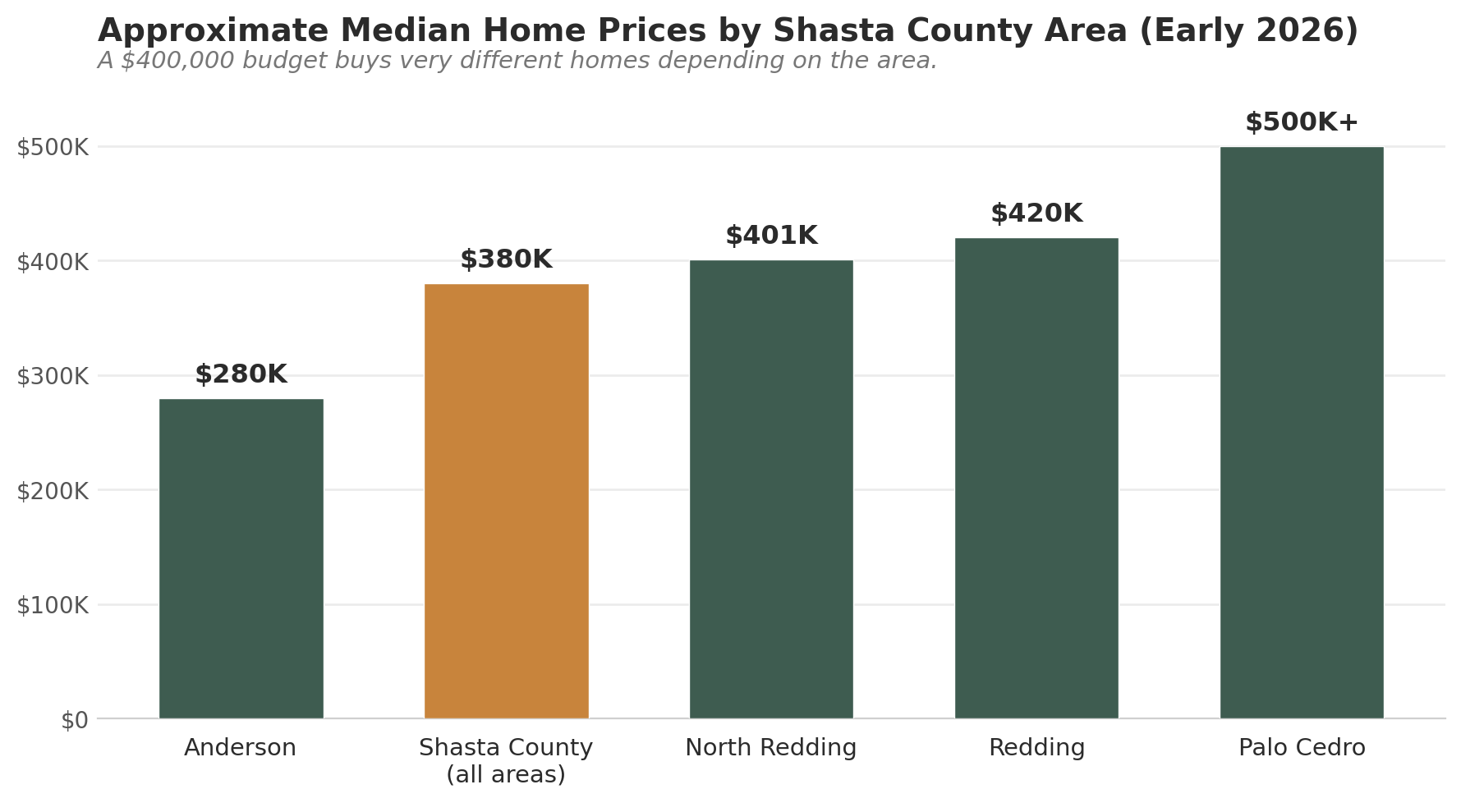
A three-bedroom in Palo Cedro and a three-bedroom in Shasta Lake can be twenty minutes apart and live in completely different markets. The spread across the county is wide, and a single budget stretches very differently depending on where you look.
This is exactly why the median number alone cannot tell you what your home is worth. Anderson, Redding, and Palo Cedro are not one market. They are several, each moving on its own.
Size, Condition, and Updates
Square footage, bedroom and bathroom count, and lot size form the baseline, but condition is what moves the final number. Buyers reward homes that are clean, well maintained, and move-in ready. Functional updates tend to return the most: kitchens, bathrooms, roofing, HVAC, and flooring.
Deferred maintenance works in reverse, since buyers mentally subtract the cost of every repair they can see, and they usually subtract more than the repair would actually cost you to fix.
Recent Comparable Sales
Comps are the backbone of any credible valuation. The strongest ones are homes near yours that sold in the last three to six months, as close as possible in size, age, layout, and style.
Sold prices matter, not asking prices, because a list price is only a hope until a buyer agrees to it. Active listings show you the competition, but closed sales show you what buyers are truly paying right now.
Wildfire Risk and Insurability
This is the Shasta County factor national tools ignore, and in 2026 it is one of the most important. Much of the county sits in elevated fire severity zones, and major carriers such as State Farm and Allstate have pulled back from writing new policies in California.
When buyers struggle to find affordable coverage, or get pushed toward the state FAIR Plan, it directly affects what they can pay. A home that is hard or expensive to insure is harder to sell, and that pressure can show up in the final price.
The flip side is an opportunity. Homes with documented defensible space, hardened features, or a Wildfire Prepared certification give buyers and insurers confidence, which protects both salability and value.
Why Your Property Tax Assessment Is Not Your Market Value

Many homeowners glance at their tax bill and assume the assessed value is what the home is worth. In California, the two numbers are rarely the same, and the gap is usually in your favor.
How Prop 13 Caps Your Tax Assessment
Under Proposition 13, your assessed value is generally set at what you paid for the home, and the county can raise that figure by no more than 2 percent per year for as long as you own it.
The median effective property tax rate in Redding runs about 1.05 percent, so a $400,000 home carries roughly $4,200 a year. Prop 13 keeps that assessment predictable, which is great for budgeting but means the tax roll quietly falls behind the real market.
Why Assessed Value and Market Value Drift Apart
The longer you have owned your home, the wider the gap tends to grow. If you bought years ago and values have climbed since, your assessed value may sit far below what the home would sell for today.
That is why the assessor's figure is useful for estimating taxes and almost useless for estimating sale price. Market value reflects today's buyers and today's comparable sales. Your assessment reflects the year you bought and a capped climb ever since.
Find Out What Your Redding Home Is Really Worth
An online estimate is a fine place to start a daydream, but it cannot account for your neighborhood, your upgrades, your insurability, or the buyers active in Shasta County this month.
The only way to know what your home will actually sell for is a comparative market analysis built on real, recent local sales and an honest look at your specific property.
That is exactly what we do at Greater Life Realty. We track these numbers across Redding, Anderson, Palo Cedro, Cottonwood, Shasta Lake, and the surrounding communities every single day, and we will give you a clear, no-pressure valuation tied to your exact home and neighborhood.
If you are even thinking about selling a home in Redding, CA, knowing your real number is the first smart step. Reach out today for a free home valuation and let us guide you home to a greater life.
